LOYALZ

From copper token to AI: 26 milestones in loyalty programmes

26 milestones in loyalty programmes over two centuries, from the Rochdale Pioneers' dividend to AI-built challenges. With sources for each.
By the LOYALZ team · · 11 min read
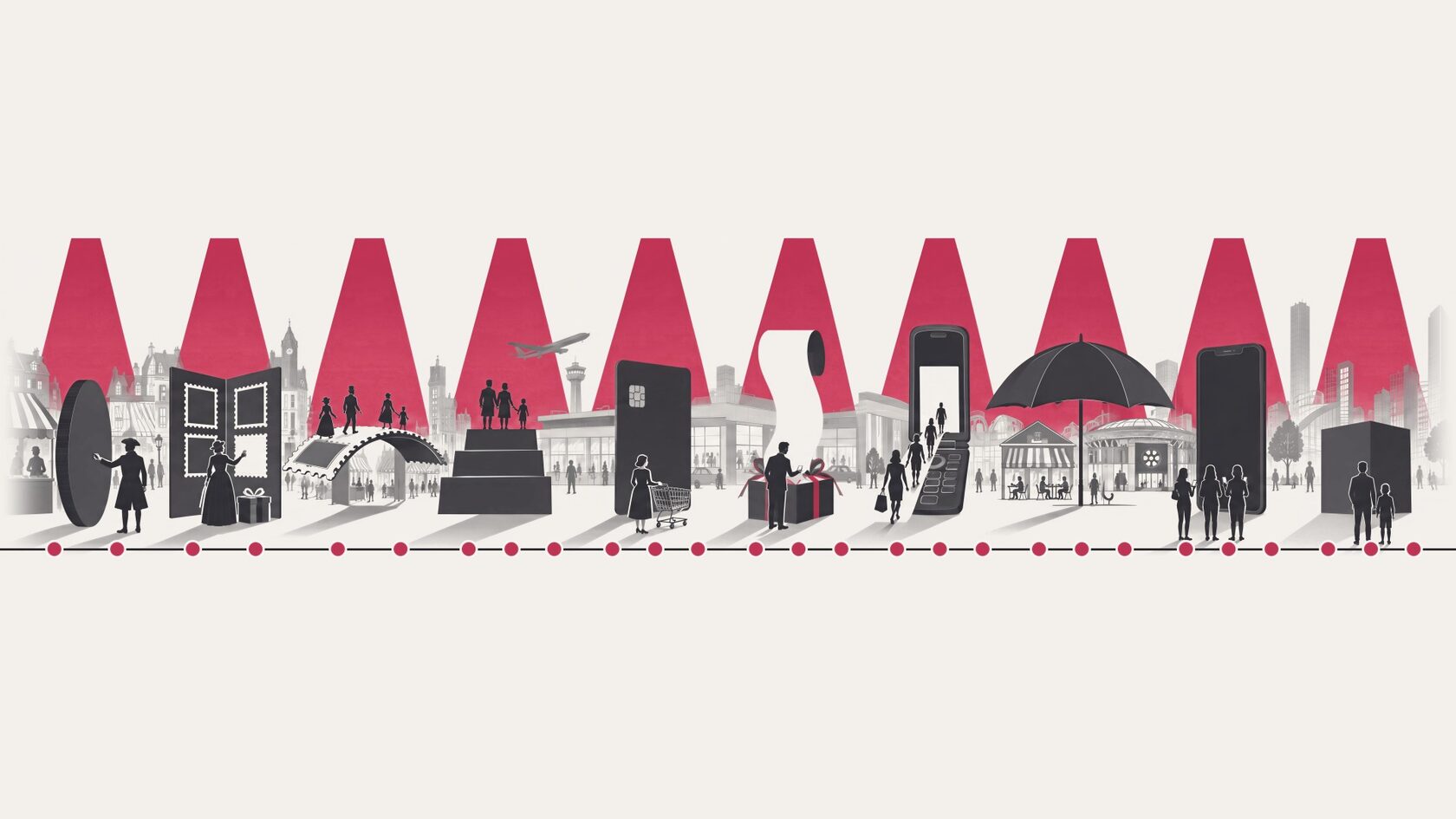
Loyalty programme symbols from a copper token to a smartphone under raspberry beams along a timeline

The story goes that it all started in 1793, when a shopkeeper in Sudbury handed out copper tokens to put towards the next purchase. A Sudbury copper token from 1793 really does exist – it is held by the Fitzwilliam Museum in Cambridge. But it was small change, struck when copper coin was scarce, and there is no evidence it was ever used to reward regular customers. Myth or fact? You decide.

From here on, we include only what company archives, museums and the press of the time can confirm. For each idea we looked for the earliest verifiable example. Where the claim to be first is disputed, we say so, and the sources are listed at the end.

Paper, stamps and wrappers: 1793–1896

1793 · England · Sudbury copper token: a token towards the next purchase – myth or fact?

A halfpenny token from the town of Sudbury in Suffolk: the obverse carries the town's arms and "May the trade of Sudbury flourish"; the edge reads "Payable at Goldsmiths". Tokens like this were struck privately when official copper coin ran short, and could be exchanged for coin. The legend of a shopkeeper rewarding loyal customers with them is usually traced to a New York Times article of 26 December 1971, whose headline already hedges with "said to". In later retellings Sudbury moved to New Hampshire, which has no town of that name. [1]

1844 · England · Rochdale Pioneers: part of the profit goes back to members in proportion to their purchases

The society's shop on Toad Lane opened on 21 December 1844, and after its first year members received a dividend on purchases: part of the surplus was returned to each of them in proportion to what they had bought. Purchases were first recorded in a book; co-operatives later moved to metal checks that members kept until "divi day". The idea had appeared in the 1820s, but it was Rochdale that made it the standard for the co-operative movement. [2]

1872 · France · Liebig: collect a set of cards from the packs

The meat-extract maker issued series of chromolithograph cards, usually six to a set. At first shopkeepers handed them out; later a complete set could be had in exchange for coupons from the packs. To finish a series, you had to come back and buy again. [3]

1891 · USA · Schuster's: stamps for purchases go into a book, and a full book buys a gift

The Milwaukee department store gave trading stamps with purchases. Customers stuck them into a book and exchanged a full book for goods. The scheme was known as the Blue Trading Stamp System. Some sources date it to 1890. [4]

1894 · USA · B. T. Babbitt: wrappers as currency in a manufacturer's programme

A manufacturer's programme in which soap wrappers became currency. An 1894 poster sets out the terms: trade marks cut from the wrappers could be exchanged for a picture. Babbitt is often said to have been doing this since the 1850s, but dated evidence only goes back to the 1890s. [5]

1896 · USA · Sperry & Hutchinson: an early form of coalition

The first independent trading-stamp operator: many different shops gave out S&H Green Stamps, and customers redeemed them at S&H centres. The first stamps appeared in shops in Jackson, Michigan; the first redemption centre opened in 1897, and by its second year the scheme was running in 67 cities. In effect, it was an early form of coalition: one currency across many independent retailers. [6]

Clubs, miles and communities: 1954–1983

1954 · USA · FedMart: only club members can shop

Sol Price's store in San Diego opened on 3 December 1954 and sold only to members: a lifetime membership cost $2 and was open to government employees and veterans. It was modelled on Fedco (Los Angeles, 1948). Twenty-two years later Price opened Price Club, where annual membership fees became the warehouse-club format's main source of profit. [7]

1981 · USA · American Airlines AAdvantage: miles for flights, and tiers a year later

The programme launched on 1 May 1981: miles were tracked automatically by the reservation system and built up towards a reward. United launched its own programme five days later, and in July 1982 AAdvantage added its first elite tiers. American itself calls AAdvantage "one of the first": Western Airlines had tried something similar in the 1970s, and Texas International in 1979. [8]

1983 · USA · Harley Owners Group: community as the core of the programme

An owners' club set up by the manufacturer itself. Work began in September 1982, and local chapters were running by the end of 1983. The first benefits were roadside assistance and a theft reward, but the real draw was group rides and events. Loyalty built on community, not discounts. [9]

Cards and data: 1984–2000

1984 · USA · Diners Club: rewards on a payment card

The company calls Club Rewards "the industry's first rewards program", meaning the payment-card industry. Diners Club was owned by Citicorp at the time. US trademark records show the mark in use from May 1985. Things moved quickly after that: Discover offered cashback in 1986, and in 1987 Citi and American Airlines launched a co-branded card that earned miles. [10]

1987 · USA · Ukrop's: a loyalty card at the till

The Richmond, Virginia, supermarket chain introduced the bar-coded Valued Customer card, which applied electronic coupons automatically at the checkout. Progressive Grocer calls it the first loyalty card programme in the country. [11]

1988 · UK · Air Miles: a modern coalition with a single currency

Keith Mills founded Air Miles in 1988, with British Airways taking around half the company. The model was built around empty aircraft seats: miles earned on purchases with different partners were exchanged for flights. A modern coalition with a single currency. A later company founded by Mills launched Nectar (2002). [12]

1990 · USA · Waldenbooks: a paid club, with a fee for the discount

The bookseller launched Preferred Reader in March 1990: for $5 a year, members got 10% off every purchase and a $5 certificate for every $100 spent. By July 1990 the programme had a million members, and 3.8 million by 1991. A paid club for extra benefits, not a fee to get through the door. [13]

1994 · Australia · FlyBuys: a coalition with a retailer at the centre

The coalition launched in July 1994 as a joint venture between the retailer Coles Myer, the fuel company Shell and the bank NAB. A retailer, not an airline, sat at the centre. [14]

1995 · USA · Ukrop's: personal offers based on purchase history

By March 1995 Ukrop's was mailing 293 000 members coupons "tailored to individual households based on their purchasing patterns" – for instance, a coupon for a baby blanket to households buying nappies. Customers were grouped by behaviour, and the top 10% – who accounted for 40% of sales – were singled out. [15]

1995 · UK · Tesco Clubcard: purchase data as the main asset

The national launch came on 13 February 1995, after a trial in nine stores and three months of analysis by dunnhumby. Purchase data became the retailer's main asset: according to the people behind the programme, coupons had been personalised one-to-one by 1997; in 1999 the mailing went out in 145 000 versions, and by 2007 in 7 million combinations a quarter. [16]

2000 · USA · Harrah's Total Rewards: predicting customer value

The casino group predicted each player's lifetime value from their card data and tailored offers individually. If a customer started visiting less often, they got a letter, a call or a cash offer. According to The Wall Street Journal, average visits rose from 1.1 to 1.4 a month. [17]

Phones and ecosystems: 2004–2010

2004 · Japan · Bic Camera: the loyalty card moves into the phone

In July 2004 NTT Docomo launched its "wallet phone" service, based on the FeliCa chip. Bic Camera points were among the first services: the phone itself worked as the loyalty card, with no plastic needed. [18]

2006 · Japan · Rakuten: one set of points for a whole ecosystem

Rakuten points appeared in November 2002 on the Ichiba marketplace, and by spring 2003 members were earning them on auctions and travel too. In 2006 the company announced the Rakuten Ecosystem: a membership-based model in which one account and one set of points work across all the group's services. By 2017 there were more than 70 of them. [19]

2006 · USA · My Coke Rewards and Nike+: experiences and content instead of discounts

In February 2006 Coca-Cola launched My Coke Rewards: codes from bottle caps could be exchanged for music, films and experiences such as a trip to the basketball Final Four. In May, Nike and Apple unveiled Nike+iPod: what counted now was not purchases but runs, and the reward was data, goals and community. [20]

2008 · USA · Starbucks Gold: a paid tier within the programme

A paid tier at $25 a year with 10% off, alongside the free Starbucks Card Rewards programme. In December 2009 the two were merged into the free My Starbucks Rewards. Paid tiers inside mass-market programmes came back later; the best-known example is Tesco Clubcard Plus (2019). [21]

2009 · USA · Starbucks: the programme moves into the brand's app

On 23 September 2009 Starbucks released its iPhone apps. Starbucks Card Mobile showed the card balance and let customers top it up, and barcode payment was trialled in 16 stores before going chain-wide in January 2011. The programme had moved into the brand's own app. In Japan, brand apps with loyalty features had been around since 2004. [22]

2010 · USA · Shopkick: a stand-alone loyalty app

A stand-alone app with its own currency, kickbucks, accepted by many retailers – Best Buy, Macy's, American Eagle, Sports Authority. Members earned points simply for walking into a store. Foursquare check-ins (2009) paved the way. [23]

Blockchain, NFTs and AI: 2018–2024

2018 · Singapore · Singapore Airlines KrisPay: miles in a blockchain wallet

Miles in a blockchain-based wallet: announced on 5 February and launched on 24 July 2018. Members could pay at partners with as few as 15 miles. [24]

2022 · Latvia · airBaltic: NFTs that confer status in the programme

In October 2022 the airline released its Planies NFT collection: the tokens earned airBaltic Club points, and from 2023 they also gave holders the programme's top status. Starbucks launched its own NFT programme, Odyssey, in December 2022 and closed it on 31 March 2024. [25]

2024 · UK · Tesco: AI builds personal challenges

In April 2024 Tesco launched Clubcard Challenges: AI sets each of 3 million members 20 personal challenges with bonus points. Starbucks had been using machine learning for personalised offers since 2016. [26]

What has changed in two centuries

The mechanics have barely changed in two centuries – they've simply moved from paper to plastic to phones. What has changed is the programme's role: it has grown from a sales tool into part of customers' lives, and sometimes into the heart of the business.

What will the next milestone be?


LOYALZ is not affiliated with, endorsed by or acting on behalf of the companies mentioned. This article is based on publicly available sources and reflects LOYALZ's opinion. Company and programme names are used for identification only and belong to their respective owners.

Sources
  1. Fitzwilliam Museum, Cambridge, CM.BI.2088-R.
  2. Co-operative Heritage Trust, "The co-op dividend – what is it?" (2020, updated 2025); Harvard Art Museums, Social Museum Collection.
  3. Smithsonian Institution, National Museum of African Art, Eliot Elisofon Archives, EEPA 2008-005.
  4. F. W. Gallant, "Trading Stamps", Boston University (1959); Smithsonian Magazine (2026).
  5. The Henry Ford, Babbitt poster, 1894 (object 127028).
  6. Hagley Museum and Library, "Free with Purchase"; Smithsonian Magazine (2026).
  7. R. E. Price, "Sol Price: Retail Revolutionary: The FedMart Years", Journal of San Diego History, vol. 56, no. 4 (2010).
  8. American Airlines Newsroom, "AAdvantage Celebrates 40 Years" (2021); InsideFlyer (12 May 2006).
  9. Harley-Davidson, "The Birth of H.O.G." (2025).
  10. Diners Club International, "History and Legacy"; USPTO, Club Rewards trademark (serial no. 73796540).
  11. Progressive Grocer, "100 Years of Food Retailing"; Supermarket News (27 June 1994).
  12. University of Essex, honorary degree oration for Keith Mills (2013); Marketing Week (1998).
  13. USPTO, Waldenbooks Preferred Reader trademark (first use 2 March 1990); Publishers Weekly (2020).
  14. State Library Victoria, Coles Myer archive (1994); Retailbiz (18 February 2011).
  15. Supermarket News (6 March 1995).
  16. Computer Weekly, "Clubcard at 30" (22 January 2025); Campaign, "Scoring Points: Tesco Clubcard hits 10"; InPublishing (1 November 2007).
  17. The Wall Street Journal, "Lucky Numbers" (4 May 2000); G. Loveman, "Diamonds in the Data Mine", Harvard Business Review (May 2003).
  18. NTT Docomo (16 June 2004); ITmedia (9 July 2004).
  19. Rakuten Group, "Our History"; Internet Watch (15 April 2003); Rakuten Today (22 August 2017).
  20. BevNET (28 February 2006); Apple Newsroom (23 May 2006).
  21. Nation's Restaurant News (22 October 2008); Tesco PLC (2 October 2019).
  22. Nation's Restaurant News (23 September 2009); MacTech (19 January 2011).
  23. Chief Marketer (17 August 2010).
  24. Singapore Airlines, press releases (5 February 2018 and 24 July 2018).
  25. airBaltic Outlook (October 2022); Investment and Development Agency of Latvia (9 February 2023); TechCrunch (8 December 2022).
  26. Mobile Marketing (30 April 2024); GeekWire (19 December 2016).
Share
First Step
A short, free call about your programme: what to check first and where money is leaking.
LOYALZ
Joining the dots between loyalty and results
Locations
Almaty
Dubai
Tashkent
Meydan Racecourse, Al Meydan Road, Nad Al Sheba 1, Dubai, UAE
© 2026 LOYALZPrivacy Policy
LOYALZ
EN / RU

From copper token to AI: 26 milestones in loyalty programmes

26 milestones in loyalty programmes over two centuries, from the Rochdale Pioneers' dividend to AI-built challenges. With sources for each.
By the LOYALZ team · · 11 min read
Loyalty programme symbols from a copper token to a smartphone under raspberry beams along a timeline

The story goes that it all started in 1793, when a shopkeeper in Sudbury handed out copper tokens to put towards the next purchase. A Sudbury copper token from 1793 really does exist – it is held by the Fitzwilliam Museum in Cambridge. But it was small change, struck when copper coin was scarce, and there is no evidence it was ever used to reward regular customers. Myth or fact? You decide.

From here on, we include only what company archives, museums and the press of the time can confirm. For each idea we looked for the earliest verifiable example. Where the claim to be first is disputed, we say so, and the sources are listed at the end.

Paper, stamps and wrappers: 1793–1896

1793 · England · Sudbury copper token: a token towards the next purchase – myth or fact?

A halfpenny token from the town of Sudbury in Suffolk: the obverse carries the town's arms and "May the trade of Sudbury flourish"; the edge reads "Payable at Goldsmiths". Tokens like this were struck privately when official copper coin ran short, and could be exchanged for coin. The legend of a shopkeeper rewarding loyal customers with them is usually traced to a New York Times article of 26 December 1971, whose headline already hedges with "said to". In later retellings Sudbury moved to New Hampshire, which has no town of that name. [1]

1844 · England · Rochdale Pioneers: part of the profit goes back to members in proportion to their purchases

The society's shop on Toad Lane opened on 21 December 1844, and after its first year members received a dividend on purchases: part of the surplus was returned to each of them in proportion to what they had bought. Purchases were first recorded in a book; co-operatives later moved to metal checks that members kept until "divi day". The idea had appeared in the 1820s, but it was Rochdale that made it the standard for the co-operative movement. [2]

1872 · France · Liebig: collect a set of cards from the packs

The meat-extract maker issued series of chromolithograph cards, usually six to a set. At first shopkeepers handed them out; later a complete set could be had in exchange for coupons from the packs. To finish a series, you had to come back and buy again. [3]

1891 · USA · Schuster's: stamps for purchases go into a book, and a full book buys a gift

The Milwaukee department store gave trading stamps with purchases. Customers stuck them into a book and exchanged a full book for goods. The scheme was known as the Blue Trading Stamp System. Some sources date it to 1890. [4]

1894 · USA · B. T. Babbitt: wrappers as currency in a manufacturer's programme

A manufacturer's programme in which soap wrappers became currency. An 1894 poster sets out the terms: trade marks cut from the wrappers could be exchanged for a picture. Babbitt is often said to have been doing this since the 1850s, but dated evidence only goes back to the 1890s. [5]

1896 · USA · Sperry & Hutchinson: an early form of coalition

The first independent trading-stamp operator: many different shops gave out S&H Green Stamps, and customers redeemed them at S&H centres. The first stamps appeared in shops in Jackson, Michigan; the first redemption centre opened in 1897, and by its second year the scheme was running in 67 cities. In effect, it was an early form of coalition: one currency across many independent retailers. [6]

Clubs, miles and communities: 1954–1983

1954 · USA · FedMart: only club members can shop

Sol Price's store in San Diego opened on 3 December 1954 and sold only to members: a lifetime membership cost $2 and was open to government employees and veterans. It was modelled on Fedco (Los Angeles, 1948). Twenty-two years later Price opened Price Club, where annual membership fees became the warehouse-club format's main source of profit. [7]

1981 · USA · American Airlines AAdvantage: miles for flights, and tiers a year later

The programme launched on 1 May 1981: miles were tracked automatically by the reservation system and built up towards a reward. United launched its own programme five days later, and in July 1982 AAdvantage added its first elite tiers. American itself calls AAdvantage "one of the first": Western Airlines had tried something similar in the 1970s, and Texas International in 1979. [8]

1983 · USA · Harley Owners Group: community as the core of the programme

An owners' club set up by the manufacturer itself. Work began in September 1982, and local chapters were running by the end of 1983. The first benefits were roadside assistance and a theft reward, but the real draw was group rides and events. Loyalty built on community, not discounts. [9]

Cards and data: 1984–2000

1984 · USA · Diners Club: rewards on a payment card

The company calls Club Rewards "the industry's first rewards program", meaning the payment-card industry. Diners Club was owned by Citicorp at the time. US trademark records show the mark in use from May 1985. Things moved quickly after that: Discover offered cashback in 1986, and in 1987 Citi and American Airlines launched a co-branded card that earned miles. [10]

1987 · USA · Ukrop's: a loyalty card at the till

The Richmond, Virginia, supermarket chain introduced the bar-coded Valued Customer card, which applied electronic coupons automatically at the checkout. Progressive Grocer calls it the first loyalty card programme in the country. [11]

1988 · UK · Air Miles: a modern coalition with a single currency

Keith Mills founded Air Miles in 1988, with British Airways taking around half the company. The model was built around empty aircraft seats: miles earned on purchases with different partners were exchanged for flights. A modern coalition with a single currency. A later company founded by Mills launched Nectar (2002). [12]

1990 · USA · Waldenbooks: a paid club, with a fee for the discount

The bookseller launched Preferred Reader in March 1990: for $5 a year, members got 10% off every purchase and a $5 certificate for every $100 spent. By July 1990 the programme had a million members, and 3.8 million by 1991. A paid club for extra benefits, not a fee to get through the door. [13]

1994 · Australia · FlyBuys: a coalition with a retailer at the centre

The coalition launched in July 1994 as a joint venture between the retailer Coles Myer, the fuel company Shell and the bank NAB. A retailer, not an airline, sat at the centre. [14]

1995 · USA · Ukrop's: personal offers based on purchase history

By March 1995 Ukrop's was mailing 293 000 members coupons "tailored to individual households based on their purchasing patterns" – for instance, a coupon for a baby blanket to households buying nappies. Customers were grouped by behaviour, and the top 10% – who accounted for 40% of sales – were singled out. [15]

1995 · UK · Tesco Clubcard: purchase data as the main asset

The national launch came on 13 February 1995, after a trial in nine stores and three months of analysis by dunnhumby. Purchase data became the retailer's main asset: according to the people behind the programme, coupons had been personalised one-to-one by 1997; in 1999 the mailing went out in 145 000 versions, and by 2007 in 7 million combinations a quarter. [16]

2000 · USA · Harrah's Total Rewards: predicting customer value

The casino group predicted each player's lifetime value from their card data and tailored offers individually. If a customer started visiting less often, they got a letter, a call or a cash offer. According to The Wall Street Journal, average visits rose from 1.1 to 1.4 a month. [17]

Phones and ecosystems: 2004–2010

2004 · Japan · Bic Camera: the loyalty card moves into the phone

In July 2004 NTT Docomo launched its "wallet phone" service, based on the FeliCa chip. Bic Camera points were among the first services: the phone itself worked as the loyalty card, with no plastic needed. [18]

2006 · Japan · Rakuten: one set of points for a whole ecosystem

Rakuten points appeared in November 2002 on the Ichiba marketplace, and by spring 2003 members were earning them on auctions and travel too. In 2006 the company announced the Rakuten Ecosystem: a membership-based model in which one account and one set of points work across all the group's services. By 2017 there were more than 70 of them. [19]

2006 · USA · My Coke Rewards and Nike+: experiences and content instead of discounts

In February 2006 Coca-Cola launched My Coke Rewards: codes from bottle caps could be exchanged for music, films and experiences such as a trip to the basketball Final Four. In May, Nike and Apple unveiled Nike+iPod: what counted now was not purchases but runs, and the reward was data, goals and community. [20]

2008 · USA · Starbucks Gold: a paid tier within the programme

A paid tier at $25 a year with 10% off, alongside the free Starbucks Card Rewards programme. In December 2009 the two were merged into the free My Starbucks Rewards. Paid tiers inside mass-market programmes came back later; the best-known example is Tesco Clubcard Plus (2019). [21]

2009 · USA · Starbucks: the programme moves into the brand's app

On 23 September 2009 Starbucks released its iPhone apps. Starbucks Card Mobile showed the card balance and let customers top it up, and barcode payment was trialled in 16 stores before going chain-wide in January 2011. The programme had moved into the brand's own app. In Japan, brand apps with loyalty features had been around since 2004. [22]

2010 · USA · Shopkick: a stand-alone loyalty app

A stand-alone app with its own currency, kickbucks, accepted by many retailers – Best Buy, Macy's, American Eagle, Sports Authority. Members earned points simply for walking into a store. Foursquare check-ins (2009) paved the way. [23]

Blockchain, NFTs and AI: 2018–2024

2018 · Singapore · Singapore Airlines KrisPay: miles in a blockchain wallet

Miles in a blockchain-based wallet: announced on 5 February and launched on 24 July 2018. Members could pay at partners with as few as 15 miles. [24]

2022 · Latvia · airBaltic: NFTs that confer status in the programme

In October 2022 the airline released its Planies NFT collection: the tokens earned airBaltic Club points, and from 2023 they also gave holders the programme's top status. Starbucks launched its own NFT programme, Odyssey, in December 2022 and closed it on 31 March 2024. [25]

2024 · UK · Tesco: AI builds personal challenges

In April 2024 Tesco launched Clubcard Challenges: AI sets each of 3 million members 20 personal challenges with bonus points. Starbucks had been using machine learning for personalised offers since 2016. [26]

What has changed in two centuries

The mechanics have barely changed in two centuries – they've simply moved from paper to plastic to phones. What has changed is the programme's role: it has grown from a sales tool into part of customers' lives, and sometimes into the heart of the business.

What will the next milestone be?


LOYALZ is not affiliated with, endorsed by or acting on behalf of the companies mentioned. This article is based on publicly available sources and reflects LOYALZ's opinion. Company and programme names are used for identification only and belong to their respective owners.

Sources
  1. Fitzwilliam Museum, Cambridge, CM.BI.2088-R.
  2. Co-operative Heritage Trust, "The co-op dividend – what is it?" (2020, updated 2025); Harvard Art Museums, Social Museum Collection.
  3. Smithsonian Institution, National Museum of African Art, Eliot Elisofon Archives, EEPA 2008-005.
  4. F. W. Gallant, "Trading Stamps", Boston University (1959); Smithsonian Magazine (2026).
  5. The Henry Ford, Babbitt poster, 1894 (object 127028).
  6. Hagley Museum and Library, "Free with Purchase"; Smithsonian Magazine (2026).
  7. R. E. Price, "Sol Price: Retail Revolutionary: The FedMart Years", Journal of San Diego History, vol. 56, no. 4 (2010).
  8. American Airlines Newsroom, "AAdvantage Celebrates 40 Years" (2021); InsideFlyer (12 May 2006).
  9. Harley-Davidson, "The Birth of H.O.G." (2025).
  10. Diners Club International, "History and Legacy"; USPTO, Club Rewards trademark (serial no. 73796540).
  11. Progressive Grocer, "100 Years of Food Retailing"; Supermarket News (27 June 1994).
  12. University of Essex, honorary degree oration for Keith Mills (2013); Marketing Week (1998).
  13. USPTO, Waldenbooks Preferred Reader trademark (first use 2 March 1990); Publishers Weekly (2020).
  14. State Library Victoria, Coles Myer archive (1994); Retailbiz (18 February 2011).
  15. Supermarket News (6 March 1995).
  16. Computer Weekly, "Clubcard at 30" (22 January 2025); Campaign, "Scoring Points: Tesco Clubcard hits 10"; InPublishing (1 November 2007).
  17. The Wall Street Journal, "Lucky Numbers" (4 May 2000); G. Loveman, "Diamonds in the Data Mine", Harvard Business Review (May 2003).
  18. NTT Docomo (16 June 2004); ITmedia (9 July 2004).
  19. Rakuten Group, "Our History"; Internet Watch (15 April 2003); Rakuten Today (22 August 2017).
  20. BevNET (28 February 2006); Apple Newsroom (23 May 2006).
  21. Nation's Restaurant News (22 October 2008); Tesco PLC (2 October 2019).
  22. Nation's Restaurant News (23 September 2009); MacTech (19 January 2011).
  23. Chief Marketer (17 August 2010).
  24. Singapore Airlines, press releases (5 February 2018 and 24 July 2018).
  25. airBaltic Outlook (October 2022); Investment and Development Agency of Latvia (9 February 2023); TechCrunch (8 December 2022).
  26. Mobile Marketing (30 April 2024); GeekWire (19 December 2016).
Share
First Step
A short, free call about your programme: what to check first and where money is leaking.
LOYALZ
Joining the dots between loyalty and results
© 2026 LOYALZPrivacy Policy